
Miles Davis at 100
At the vanguard of the century

When I was in college, I took two history courses with a professor who was easily the most politically conservative (in the mid-20th century American establishment manner) person on the entire campus: Modern European History and the History of Espionage and Diplomacy. These were tremendously illuminating and valuable in shaping my critical thinking—they in no way made me more politically conservative and the professor wasn’t interested in that, he wanted to get us to see not just the connections between ideas, actions, and ramifications, but also a less idealized and more historically informed view of human nature and how societies order themselves, interact with others, survive, and change.
We did a lot of reading, and some of it was so remarkable to me that it has stuck with me through the decades in the way of reliving the sensation of slamming into totally unexpected ideas and truly contrarian thinking, not in the shallow, reactive smugness of the political bros who plague our discourse but in the combination of radical imagination and commitment, and especially humanity. Humanity was the key in all these things, seeing people not as statistics but as people, even to dismiss them the way Trotsky at times did in My Life (one of the most gripping books I’ve ever read), Ignazio Silone’s Fontamara, his and other essays in The God That Failed, Robert Graves’ profound memoir Goodbye to All That, and others. I went into these classes (and an equally fantastic Modern American History seminar where we read Absalom, Absalom, The Armies of the Night, Soul on Ice, Let Us Now Praise Famous Men, Invisible Man—you know, the great books) with an emotional affinity for socialism and came out with a burning fire for anarchism.
I think about those classes because it was them, more than playing and studying music in any way, that today help me hear Miles Davis with clarity, and see his place in the continuum of music history and American culture. Sure, playing “The Serpent’s Tooth” and “All Blues” gave me a feel for what he was doing, but gaining a better and deeper understanding of how people are in society made it easy to see the greatness of Miles as a musician and how through music he became an essential public figure.
A political frame is useful for this: “Vanguardism” comes from Leninism, a committed cadre of experts leading the revolution and, unstated but clear, dragging everyone with them along the way, whether they want to go along or not. The 20th century was one of the consequences of this. In the arts, this is avant-gardism, the difference being that artists don’t get to rule societies and decide what’s going to happen to people. Their revolution is to press the possibilities of their field into the future by daring to go beyond, often alone. Their respective traditions often catch up to that point as T.S. Eliot explained, but they may not find the artist when they get there. They didn’t find Miles, because until his comeback years he was always pressing ahead, what he at times called a curse was his aesthetic nature.
On the Outside Looking Out
He was an avant-gardist from 1949 (the first Birth of the Cool sessions) to 1975, changing music four or five times. This is indisputable, and in plain sight. Seeing this is vital because it means seeing what makes music what it is and the vast range of possibilities in exploration. It means seeing genres, which ones are real and which don’t really exist—or shouldn’t.
I usually stay outside of genre discourse, it’s mostly nonsense that passes for cultural insight in a consumerist society. The idea of destroying genre lines or “not seeing genre” is dumb. Genres, for lack of a better word, are good, genres work. Setting some structural and stylistic markers and then seeing how far they can be pushed, reinvented, or used as a foundation for further steps is how the creative arts have developed since human cultures formed. And because they set these guidelines, genres are the prime tool for modern arts, because they’re ready made for people with imagination and skill, even without much money. Genres are where the avant-garde blooms.
The other reason why the genre wars are such nonsense in music is that not once have I seen Miles Davis included in this discourse. Not once. And Miles is the greatest genre-destroying/genre-less musician of the recording era, not just in a league of his own but a one man Big Bang-he didn’t just change music but invent new ways to make music that still have not been equalled, and in fact very little followed. I think this is because very few people hear his music for what it is: avant-garde and often experimental music that on top has stylistic signifiers like hard bop or a rock beat, melodic materials and rich harmonies. Of course, albums like Bitches Brew are easy to identify as such because of the musique concrète techniques and Miles’ disinterest in formal resolution on “Pharaoh’s Dance” and the title track. And the wild live recordings of the electric era are free jazz, full stop. With grooves.
That music hits you in the face with outrageous daring and a flaunting of almost every convention you can think of, it’s thrilling and also big, big fun. The music before may seem conservative by contrast, but it’s nothing of the sort—Miles was not only always going against the stylistic conventions of the times (playing cool in 1949? What the fuck?), but was taking apart the basic structures and forms of tonality. This is what can be hard to hear because we are in an era where avant-garde/experimental music is heard, and promoted, as a genre with specific stylistic markers, especially of noise and chaotic energy. And this is a problem because avant-gardism and experimentalism are not, and cannot be, genres—they are processes and values.
As processes, they can be extreme, cutting edge, and tonal and beautiful. In the world of music in the 1950s and ‘60s, artists like Miles and Lou Harrison (and Terry Riley and Steve Reich and Philip Glass) were the avant-garde against a consolidated consensus that had been a previous avant-garde. If the culture is atonality and serialism, the counter is tonality and aleatory. And Miles was a one-man army in this, because he was always countering—questioning and extending—what he himself had already done. The music of the second Quintet, from late summer 1964 to mid-1968, is some of the most avant-garde music made, and it is so because it is tonal. It is tonal but attacks all the rules of harmony, voice leading, etc. Miles was searching for the threshold where the least amount of organizational material could produce results that were both surprising and coherent, while still structured. The limits of the structure made the explorations possible.
Say It
Miles always had popular appeal because he was always communicating coherently to the listener, and his aesthetic sense made for a beautiful ensemble sound. People could dig him, and deeply dig they did, without having to dig him. That is an extraordinary achievement. Speaking clearly, honestly, and sincerely is the name of the game, having an expressive point and a purpose along with technical ideas. Appealing on multiple level. A sound that has a purpose behind it can achieve more than any existential gesture. That makes everything accessible, that’s why Cecil Taylor and the Art Ensemble of Chicago had broad appeal to rock listeners, that’s why Keith Jarrett is one of the greatest avant-gardists, and why Miles could make music that had no stylistic precedence and still be a popular star.
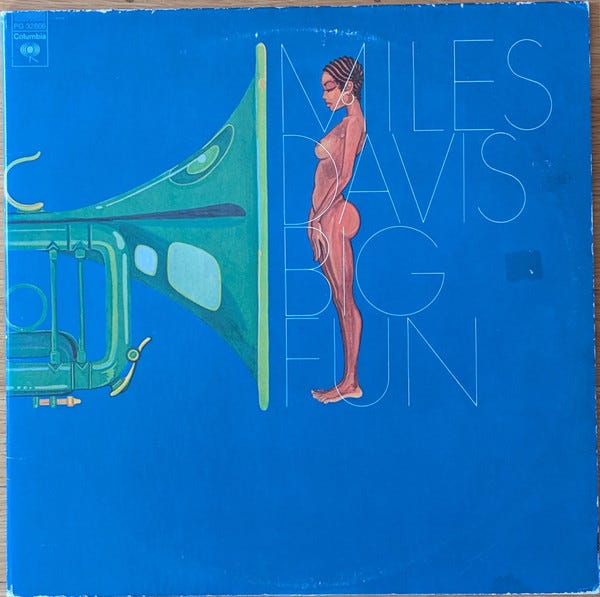
Listening forward and backward to his discography always shifts your thinking. Forward, albums like Filles di Kilimanjaro and On the Corner sound like he’s pushing into new territory. Backward, and they come off as pauses, consolidations, Miles settling for a time before he gathers new ideas. Like every other jazz musician, his discography is not always connected to his chronology, a recording made one date often was released to the public long after subsequent recording dates were published. This is especially true from the ‘60s on, with the Miles in Tokyo and Live in Berlin albums (ultra-valuable examples of Sam Rivers brief stint in the band and Wayne Shorter’s first appearance). His immensely important, daring experiment “Circle in the Round” was recored in the mid-1960s but didn’t come out until about ten years later, and Big Fun is a collection of extras from 1969 to 1972 that makes for a more focussed and coherent look at his thinking than many of the intentional studio albums. Miles always had something to say.
Miles talked about the idea of social music later in his career, and that’s the story of his whole career. As much as he could be forbidding-and it’s not like you wanted to be friends with the guy-and it seemed he didn’t give a shit about listeners because his demeanor on the bandstand was not The Acceptable Manner for Black Jazz Musicians, he always was saying something to the public that he wanted people to dig. He was up front in his autobiography about appreciating the sexual stimulation his playing could have on women, and he knew that if you had something to say people could hear it. His candor and opprobrium toward many of his peers—which also set him apart—was because he had no respect for rote statements and pandering, and he had a particular taste in beauty. When it was being put together, Miles first preferred the title Listen to This for the album that became Bitches Brew. But it also could have been What it Is. He was always what it is.
New Miles
With the combination of this big, round neon-glow like 100 years, and the obvious path for record companies to milk as much money as possible out of their back catalog, I admit I’m baffled why there has been nothing in the way of new releases or ambitious reissues out of Miles’ discography. Concord is following their collection of the 1955 Prestige recordings with one for 1956 (to be released June 19), Decca France has a deluxe reissue of the glorious Ascenseur pour l’échafaud soundtrack, the most coolest, most noir music ever made:
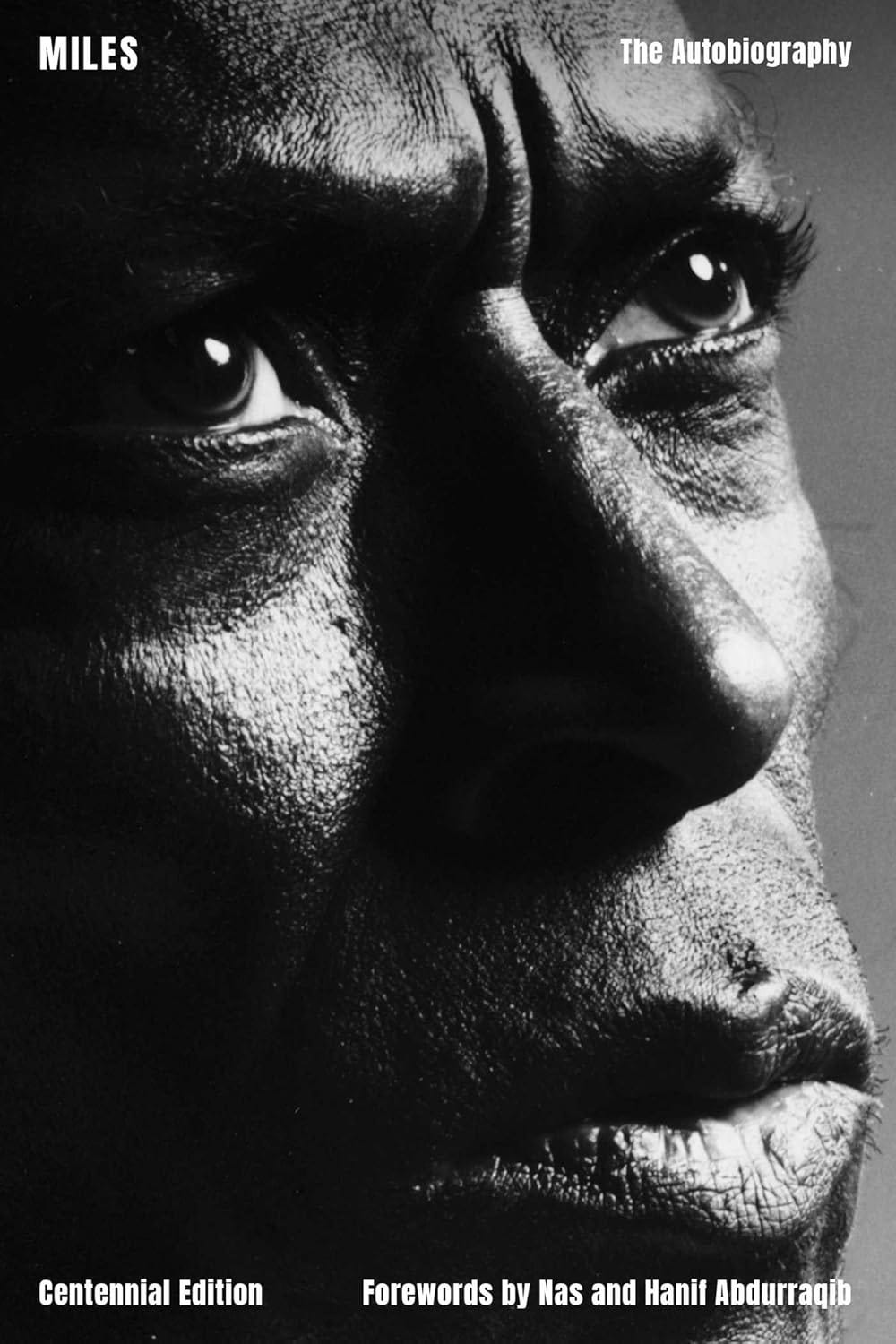
And his autobiography has been reissued in a new edition that has forewards by Nas and Hanif Abdurraqib.
That’s all good, but also it so far. I’ve heard hints from the publicity side that something else will be coming, but I’ve seen nothing. I can anticipate a lot, though. The Bootleg Series from Sony has been one of the great contributions to jazz discography, really expanding the history of his music making through key details, especially the second Quintet, the greatest small ensemble in jazz history and the band that reached a height of modern jazz that has been at times equalled by others but never surpassed. With the Bootleg sets, we can hear Wayne Shorter’s early steps in the group, the process of recording the Miles Smiles album, and completely reevaluate Herbie Hancock’s position in music over the last sixty years—his accompaniment to the solos alone on the 1967 tour set is incredible re-composing within each tune. His playing is astonishing and also incredibly avant-garde.
Of what might be left to produce, what seems to me likeliest is more extensive recordings from the 1975 tour of Japan, Miles quasi-metal—funk-free band with guitarist Pete Cosey and Reggie Lucas. The two live albums, Agharta and Pangaea, are thrilling and have few parallels, maybe moments from Can, and there has to be more. There are audience tapes floating out there, there must be more.
Possibly there are actual tapes from Miles studio meeting with Stockhausen, though as much as the two were intrigued with each other, I can’t imagine they actually produced much of anything together. One of the few good details in the otherwise bad Miles Ahead movie is that the stolen tapes Miles pursues throughout the movie, complete with car chase and gun play—not to mention the superfluous white buddy needed to make the thing acceptable to distributors—turn out to be absolute crap, some ambient noodling and nothing else. When I saw that scene, I immediately thought the joke was that these were the Stockhausen tapes. ¯\_(ツ)_/¯
Miles lives. Sonny too.
"The music of the second Quintet, from late summer 1964 to mid-1968, is some of the most avant-garde music made, and it is so because it is tonal" – EXACTLY. Not to mention the many formal innovations that followed via his collaboration with Teo Macero
Mr. Grella, what a wonderful article (can I call it that? Yes, I will), thank you. It is a very poignant coincidence that where I live, Miles' birthday fell on the same day that Sonny Rollins passed, which you alluded to at the very end of your article.