
Taking it to the Streets
"Take this message to my brother / You will find him everywhere"

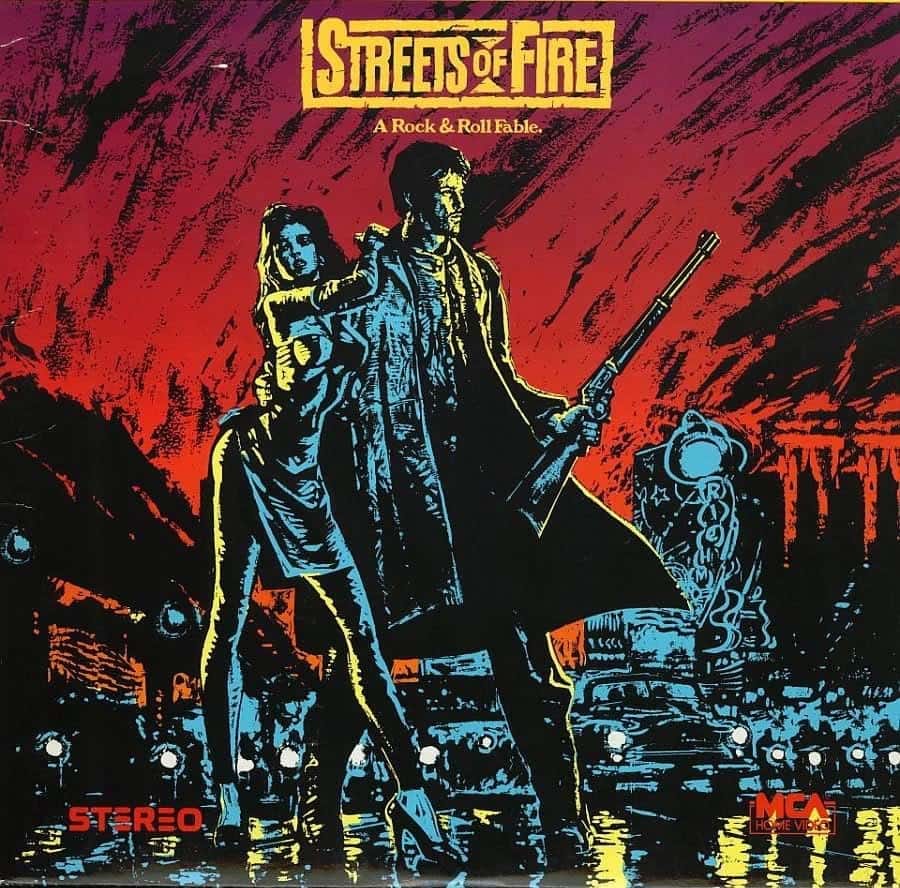
You Talkin’ to Me?
We all have a giant dichotomies, our either-this-or-that, about things we care about. I mean, there is so much stuff out there, just to preserve our sanity and make satisfying use of our time1 we have to make decisions. For listening, I think of famous aphorisms about music, quotes from Duke Ellington like: “there’s two kinds of music, good music and the other kind,” and Ornette Coleman saying the two types of music are “with words and without.”2 The use is that it covers all things while still having a critical focus.
So here’s my Grand Dichotomy® that has been simmering in my mind for over a decade, the result of live music experiences that range from 20th century high modernism to medieval music, Charles Ives to Cecil Taylor, punk rock to funk (rock), Afrobeat and reggae, Sahel blues and American blues, free and big band jazz, etc: the two kinds of music are music from the academies and music from the streets. Another way to put it is music that’s made for the cognoscenti and for the public. And give me the fucking streets.
I’m not trying to be a reverse snob, but prioritizing my values. I love Webern, Cage, Xenakis, Carter more than the next guy, and classical music and free jazz more than most. And it is both embedded in my soul and foremost in my mind that music making is a social activity, and I’m gradually starting to detest—physically!—music that doesn’t have a social component. The prime example is Erik Hall’s one-man-band recordings of Steve Reich, I get that people dig this as an impressive feat, but the lack of human interaction in the music repulses me.
Reich’s music was made to be played by a group of musicians for a live audience. Anyone with a laptop can make a good recording today and there has been a shift to creating music for recording first. Fifty years ago it was expensive and difficult for musicians at the edge to make records, they were out there playing. They were speaking to the public, to the streets.
They were not speaking as researchers inside academies speaking to other researchers in the language of systems (serialism) or citations (which has become a real problem in the new music I hear from composers with PhDs). Research language is both valid and useful, but it is less useful than street language, less varied, less expressive, shallower. It is the language of the cognoscenti, made with a deliberate component of being obscure to large audiences. Antisocial. A language of answers, rather than dialogues, a language that assumes inherent superiority rather than curiosity.
What makes me a good (I think, I hope) critic and thinker/writer about music in culture, is that I have the cognoscenti’s studies and music making behind me (ear training, fugues, free improvisation, etc) and also the experience playing and enjoying music meant to deliver good vibes whether sitting at the bar or on the dance floor. The greatest music is that which has the learned details and craft of the cognoscenti as one of the tools to speak to the public.
Should a composer, if confronted with a choice, write for the musicians who will play a piece or write for the audience who will hear it? - Glenn Branca
The immersive, close listening and thinking I’ve been doing the past couple of months has been on minimalist music, of course, and also Morton Feldman, Miles Davis, Glenn Branca (his Symphony No. 13 is at Lincoln Center June 12),3 and most recently Moondog—and come see some of the fruits of all that next week, if you can:
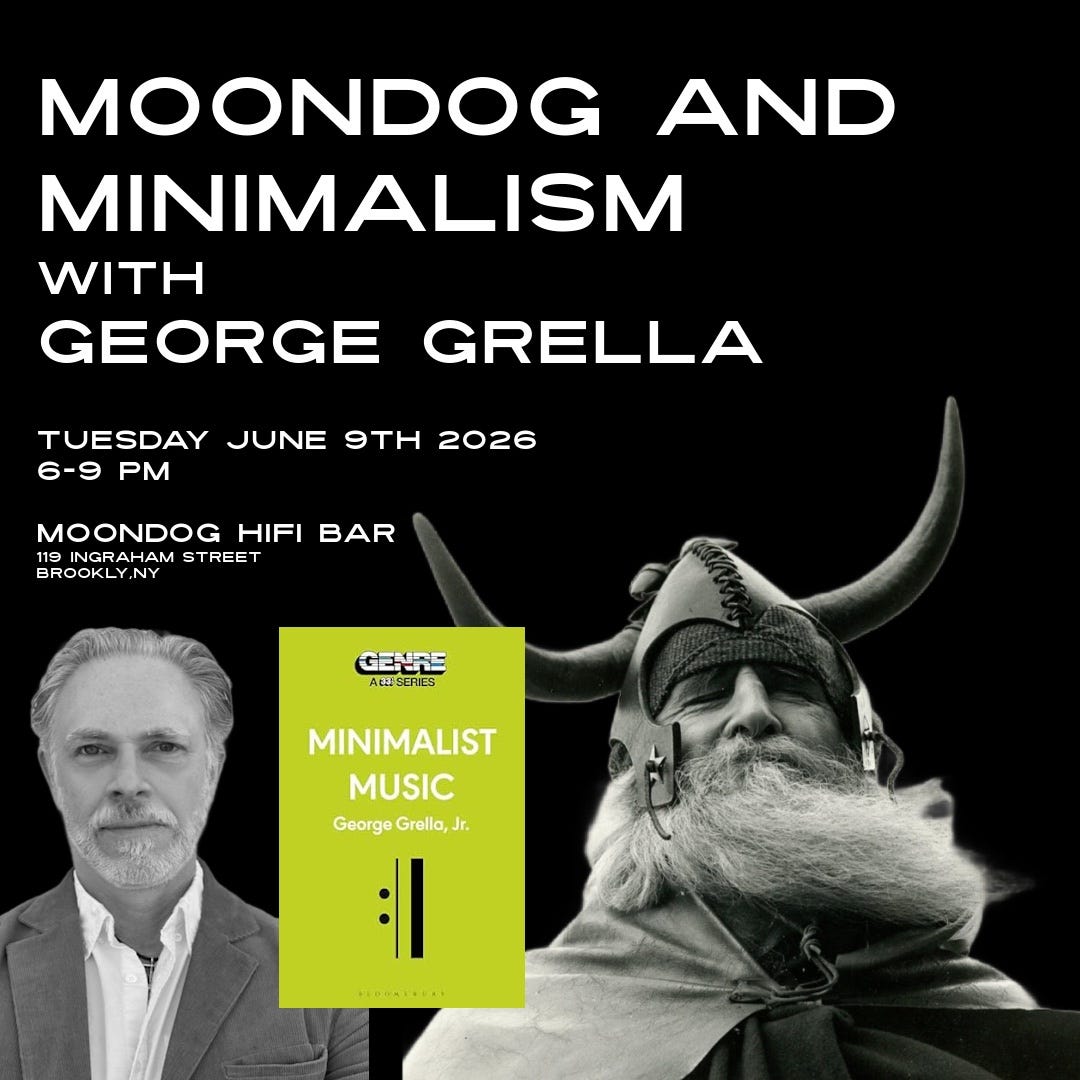
I have to type these words out in linear order, because that’s how this language works, but the actual depiction of this would be a pulsating, shifting blob, because that’s how these relationships work: Moondog in the streets and in Philip Glass’ home, “Bird’s Lament” and Charlie Parker, Reich and Glass and John Gibson playing Moondog, playing Four Organs, Glass producing no wave bands, Glenn Branca pioneering no wave music, going to Mahler concerts, making symphonies with the sound of the East Village streets because that was his language, and microtonality and Brahmsian emotional journeys were also his language. Morton Feldman writing pieces that are really as clear and simple as can be, so simple they defy useful musicological study because everything is on the surface—that’s his long appeal to people who have never heard Beethoven. Miles Davis making gorgeous, accessible small group jazz, then extreme, doom-metal avant la lettre funk, and both open and speaking to the public and both more abstract than Boulez.
This is all about Branca’s question: who is this music for, the musicians or the audience? What he didn’t say is that’s an artificial distinction that came out of the 20th century institutionalization of first the art music then the jazz traditions. When Duke Ellington was composing, he was writing for individual musicians (on a very personal basis) to express aesthetic, intellectual, and social beauty and feeling to the public, and created a body of work that is as sophisticated and soulful as music can be. His language was public language, the streets have loved it ever since, while the conservative, intellectual side, the David-Brooks-type establishment critical machine, sniffed at it, because it didn’t have the (cramped, delusional) language of the cognoscenti4. Focusing their minds on an ultra-specific idiom that signifies social position and nothing else worthwhile, the cognoscenti end up dulling their minds and shrinking their hearts. Give me the streets.
Cats can cook, and if you want to get an idea of what “sneaky bastard” sophisticates the Doobies are, here’s your man.
Album(s) of the Week
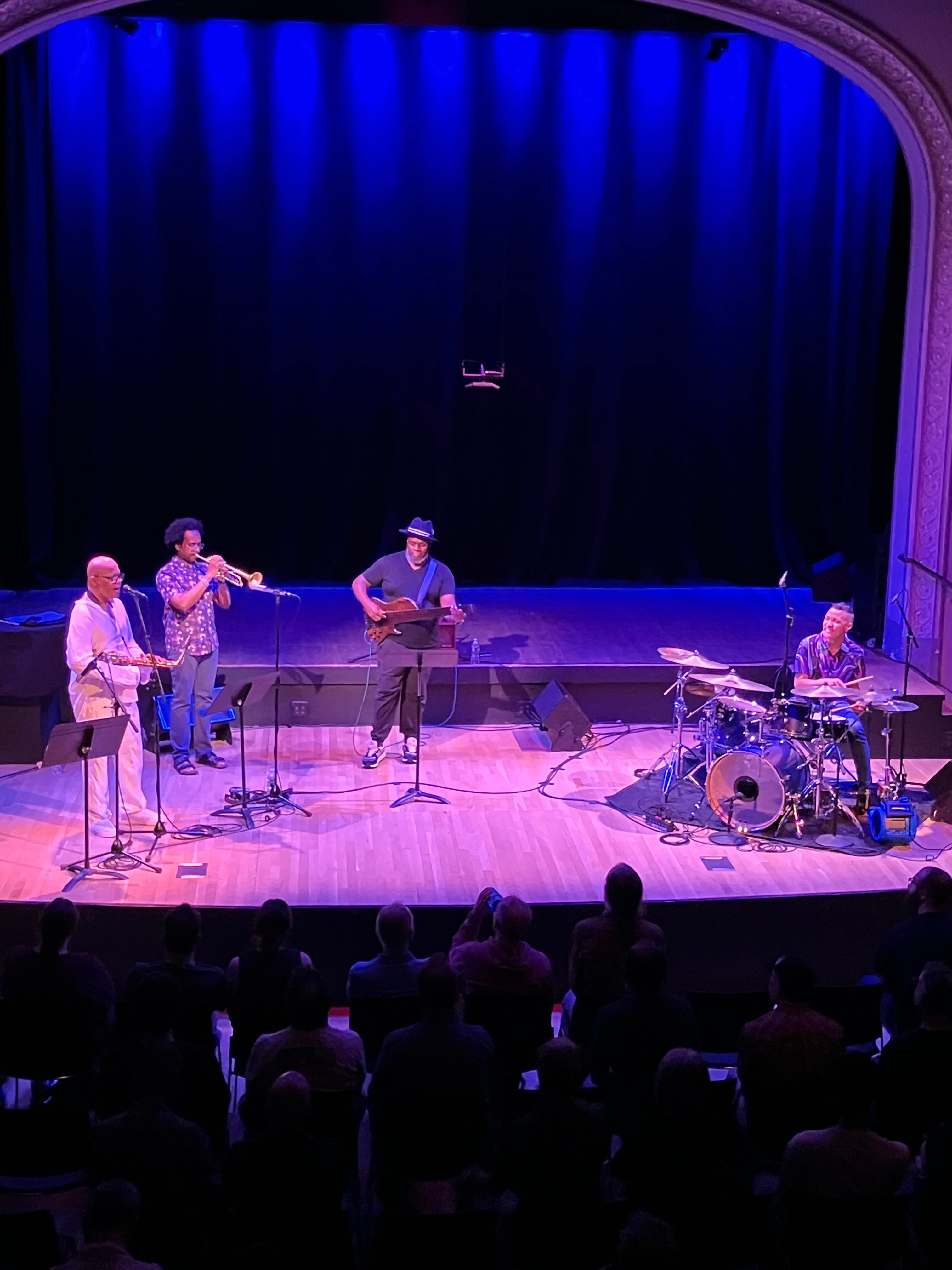
Thursday I caught the first of two nights of Pi Recordings 25th Anniversary celebration at Roulette (get tickets for Friday here): a lovely, immersive set from Marc Ribot improvising and pulling out bits and pieces of standards, swing, and his own tunes on acoustic guitar (cannot remember the last time I heard him not only play acoustic but get those ringing harmonics); then a near-insane set from Steve Coleman and Five Elements—with the incredible Anthony Tidd on bass—playing hellacious, ripping polyrhythms and stiletto phrases. You cannot get a better example of music can make your body want to groove and your mind solve differential equations and your heart thrill in human sympathy, simultaneously, than that band.
So in celebration of one of the most important contemporary jazz labels, here’s two releases you should listen to:
This is Sorey taking Max Roach’s Members, Don’t Git Weary album and making it his own. He and the band play his rearrangements of the original album, in different order though, and breaking “Equipoise” apart into a truly magnificent mini-suite. This is stunning music that will literally stop you in whatever you are doing and hold your mind and heart. How many albums do you know do that?
Recorded live, this is a different band and compositional thinking than on Sorey’s 2020 Unfiltered album,5 but the wallop and expressive intensity of the music is on that level, if not beyond. There’s an at-the-edge-of-control quality in sustained passages that is viscerally thrilling. That’s Sorey as bandleader. And Mark Shim plays tenor on this album; if you recognize the name you will be right now mashing the Buy button. And if you don’t know who he is, you should be mashing the Buy button.
This is Miles Okazaki’s newest album, dropping June 26. What I want to say about it is a thing to say about Pi, which is, you look at who’s in their discography—Henry Threadgill, Coleman, Sorey, et al—and you realize that these are THE cats in jazz in the 21st century. And Miles Okazaki is one of them, so you know what to do.
These are likely misremembered and possibly apocryphal, but not the kind of thing that demands research because you get the point.
I highly recommend this takedown of Gene Lees, Terry Teachout, et al from Ethan Iverson.
One of the greatest recordings in jazz history.
I'm not familiar with "citations" in this context. Can you point me to something that illustrates it?
Heard this, GG?
https://www.allmusic.com/album/steve-reich-music-for-18-musicians-live-in-budapest-mw0000137675
STUNNING once you hear you cannot go back.