
The Artist's Journey
“ ... the most visible sometime-avant-garde composer of his generation”


The quote about Philip Glass comes from Richard Kostelanetz, in the introduction to Writings on Glass: Essays, Interviews, Criticism. And in that clause is an entire journey (and some implicit criticism which we can ignore, because no one is obligated to be avant-garde, they are obligated to produce their best work). Glass began the serious part of his career as one of the most avant-garde composers of his generation, deliberately pushing a set of ideas as far as he could take them. Then he consolidated what he discovered into a fully realized style that was, while at the cutting edge, firmly and happily inside the classical tradition. That is a true and ideal artist’s journey.
How visible is he? More visible than the operas, the Godfrey Reggio film trilogy—he made national news this week when he announced he’s withdrawing his new Symphony No. 15, meant to honor Abraham Lincoln, from it’s previously planned world premiere by the National Symphony Orchestra, the ensemble that commissioned it. Like any intelligent and sensible person with even a micron of moral sense and backbone, he didn’t want to get that Trump stank on him by being associated with the illegal name change to the former Kennedy Center, the NSO’s performing home.
So raise a glass of something to him today to thank him and celebrate his 89th birthday (b. January 31, 1937). WKCR has a birthday broadcast planned across the twenty-four hours of January 31st, and it’s not just Glass but also Schubert (January 31, 1797 – November 19, 1828). The station points out that Schubert is Glass’ favorite composer, but the connection is much more than mere dates. Glass values old school, bedrock qualities like harmony, voice leading, and counterpoint, and his greatness and importance—beyond the sheer fineness of so much of his music—has since Music in Twelve Parts wielded these through the contemporary stylistic language of minimalism. He is a living example of how ancient traditions stay relevant, how you renew them with contemporary aesthetics and vernacular. Schubert meanwhile, especially in what for him was his late music, explored proto-minimalist elements of expanded duration—the “heavenly length” of his Symphony No. 9—and in the string quartets and piano sonatas like String Quartet No. 15 in G Major, and the B-flat Major, D. 960 Piano Sonata. Both use large and small scale repetition to build mesmerizing extended form. There is a straight line from late Schubert through Bruckner to Glass.
(The birthday broadcast began with Schubert’s hour-long String Quintet in C Major, his final chamber composition, published and premiered posthumously. Then came selections from Philip Glass Solo, followed by a Schubert Impromptu.)
Ancient to the Future
Between Glass and Reich (a very different composer), they’ve hauled 600+ years of music into the late 20th and early 21st centuries. They are complementary, with Reich skipping across the eras from Bach to Stravinsky to get to where he is, Glass working on a foundation from the classical through romantic eras, with more than a little Mozart along with his Schubert. I think there’s a similar complement in their fandoms, Reich with a more rigorous and ascetic—or at least abstract—appeal, Glass very much public facing—he has said he considers himself a theater composer—with music that has specific emotional and expressive character. That’s why his operas Akhnaten and Satyagraha are repertoire masterpieces, his Piano Etudes are a new staple and there’s more than a dozen recordings of them, and why he’s gotten so much film scoring work—and produced so many great scores. He’s been the butt of both jokes and homages on The Simpsons several times, and if that’s not cultural caché I don’t know what is.
That’s where his journey brought him, and I find it marvelous. He found a way to use repetition as a means of structure and form, discovering it’s possibilities when he worked for Ravi Shankar (the story is below in an excerpt from my book), and how to put that together with not just the tradition he loved but the pop and rock music he grew up with and loved. He produced Polyrock and went into the studio with The Raybeats; he had complete kinship with David Bowie and adapted Heroes and Low into his early symphonies; and when he heard “I Feel Love,”, “I just laughed,” he told an interviewer:
“I said, ‘That’s exactly what we’re doing!’ How could I miss it. And maybe it’s a comment on the power of the ideas we turned up in this revolution. We came up with a few…techniques. It’s like a tool…That’s what we were doing in the ‘60s, we were inventing tools. And they turned out to be very handy.”
Glass’ musical and cultural place, the way he brought music to himself, and what he gave back to it, comes through with incredible power in this remix that Crabtree did for The Handmaid’s Tale. It takes the slow middle movement of Glass Violin Concerto No. 1 and layers Debbie Harry’s vocals from “Heart of Glass” over it.
Album(s) of the Week
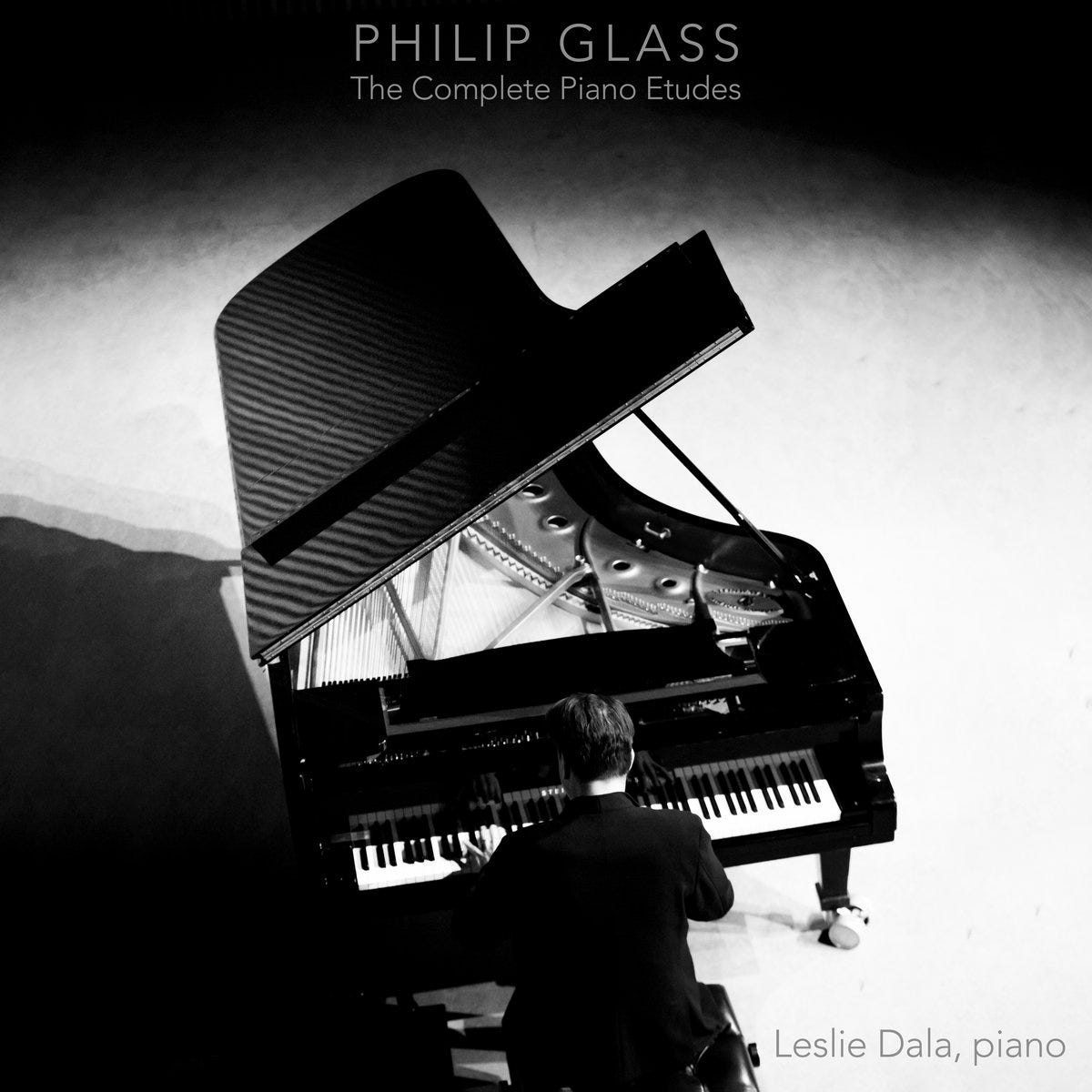
An important measure of Glass’ stature is not just how many albums of his music people have recorded, but that there are mediocre and bad ones, along with fabulous ones. Vanessa Wagner’s recent recording of the Etudes was heavily promoted, and it’s not bad but is not one I’d recommend. And an upcoming release of Glass and David Henry Hwang’s melodrama 1000 Airplanes on the Roof suffers from superficial overacting—but it’s valuable in that this was originally a Philip Glass Ensemble speciality, and new musicians picking it up puts it into the repertoire.
That’s why Ictus’ new Einstein on the Beach is invaluable even though the performance doesn’t have the depth or expression of the two by Glass. Someone else has done it, now others can. I do hope this happens with Music in Twelve Parts, because Glass no longer plays it and in the performance I saw in 2024 Michael Riesman had serious difficulty with the music. But Music for 18 Musicians is in the repertoire because some crazies decided to transcribe the ECM recording, and Glass is his own music publisher, so, let’s all be patient.
The Etudes is the one piece of music to have if you can have only one. My personal choice for the Etudes is the recording by Leslie Dala. It’s not the sharpest technically but it has all the best feels. And if you can have two albums, then you need Music in Twelve Parts, which is Glass laying out everything he learned in his avant-garde period and everything he was going to use from then on.
Enjoy the music. And for paid subscribers, here’s an excerpt from my book Minimalist Music, out April 30:
