
The Feldman Century
Quick thoughts on slow music

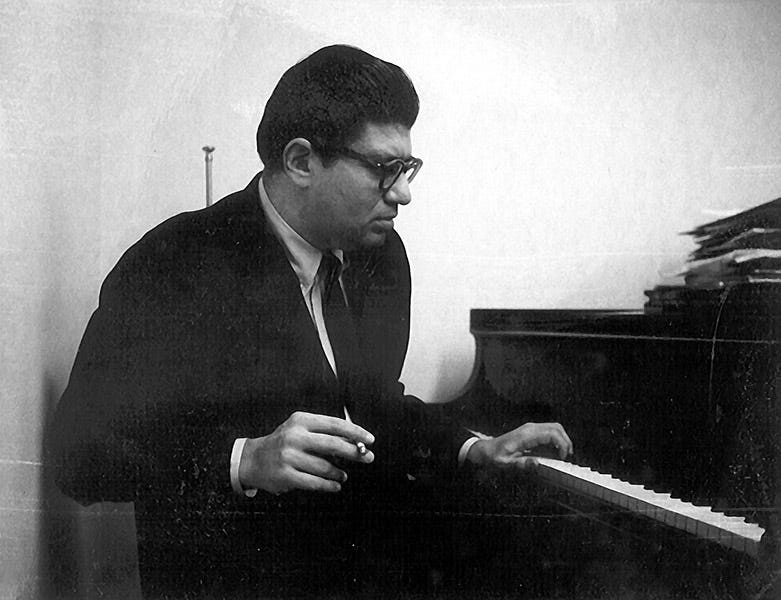
“The people who you think are radicals might really be conservatives. The people who you think are conservative might really be radical.”
- Morton Feldman Says: Selected Interviews and Lectures 1964-1987
That’s a good way for Morton Feldman, who turns 100 today, to introduce himself. Feldman is in that unusual and evocative space where the tradition connects directly to the avant-garde. His music likely has more listeners who never listen to Beethoven than those who do, but in key ways he has more to do with Beethoven than, well, his friend and colleague John Cage.
Cage is a sui generis figure, important and influential while always outside of pretty much every tradition that exists. Feldman was there with him in the beginning, experimenting with indeterminacy (different than chance operations) as a way to preserve a compositional idea but get different results in performance. When he was making his Extensions and Projections pieces in the 1950s, it was probably hard to see him as belonging to the classical tradition, but by the 1970s, he had found a way to take the sonic impression of his early music—Calder-like sound objects floating around an invisible center—and notate it, with precision, in standard Western compositional language, as in Triadic Memories:
The music is remarkable, and it’s a remarkable case of an avant-gardist finding a way to use mainstream language to express their out-of-the-mainstream ideas. Feldman’s career is also a way to see, in living memory, the mainstream catch up to a place the avant-garde staked out. He can be studied and imitated (as a compositional exercise, not a creative path) the same way Beethoven is. Looking back 100 years after his birth, it’s clear that the most important composers in post-WWII American classical music—itself a dominating feature of global culture—are Steve Reich and Morton Feldman.
Feldman has a small but key place in my book on minimalist music. There’s a porous membrane in listener culture between the motoric minimalism of Reich and the a-rhythmic, spare music of Feldman, and that connection is often more linguistic than musical. From my introductory chapter:
“Work From Home With Minimalism,” an eight hour playlist on the Tidal streaming service with tracks from music by Reich, Glass, Riley, John Adams, Michael Nyman, Arvo Pärt, William Duckworth, and yes Brian Eno, is coming through the speakers as I type this sentence. There’s another one next to it on the app’s interface titled “Minimalism for the Mind,” which is heavier on Nyman, and has some John Cage and Howard Skempton sprinkled in. In the “More Albums by …” section of the screen, there are other mood-based playlists like “Minimalism: Winter Nights” and “A Minimal Space” that swing more toward Pärt and, interestingly, Morton Feldman. However these are put together, either by a human being or (more likely) through an algorithm, they are delivering music that was once deeply avant-garde art music—and in the case of Feldman still is—to a mass audience.
Minimal and minimalist mean two different things, minimal material and activity, out-of-time music:
and process music that works directly with the flow of time:
This gets to another remarkable thing about Feldman, that he was certainly a minimal composer who’s later work absolutely fits into minimalist music, in a unique way. I discuss Feldman in terms of minimalism in my book, and for full subscribers here’s an excerpt from the uncorrected final draft:
