
Why I Like Sun Ra
I hear America being modern

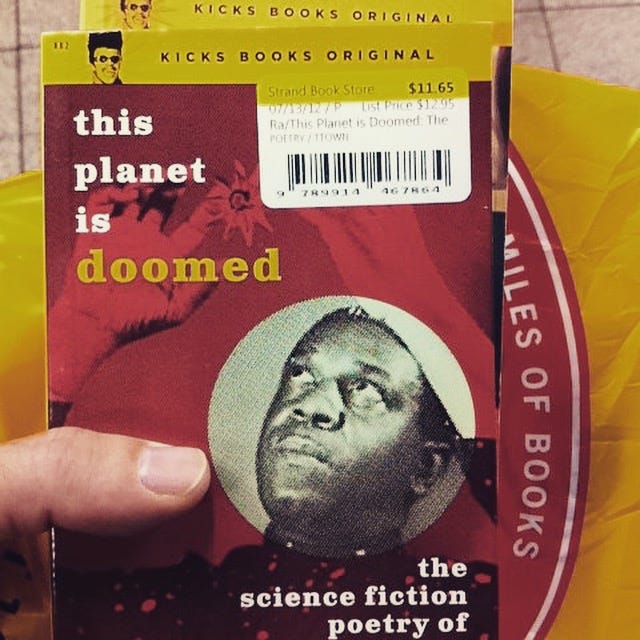
Dialogue, Not Diatribe
First of all, no disrespect to Phil Freeman, who’s recent “Why I Don’t Like Sun Ra” is the immediate motivation for this. Freeman is, first of all, clear and honest about his thinking:
I love Sun Ra. Well, I love the idea of Sun Ra. I love what Sun Ra represented. I love the impact Sun Ra had on jazz. I think the ideas Sun Ra put across in his music and his writings have extraordinary value, and merit deep study. And I think Sun Ra’s visual presentation and overall pageantry — his commitment to the bit, in comedy parlance — is fantastic.
About the only thing I don’t like about Sun Ra is his music.
That’s a personal take that is also good criticism. He’s upfront about both what he values and his taste. This is a distinction usually lost on the general public, which is that criticism has nothing to do with liking or not liking something, it has to do with understanding and evaluating it honestly on its own terms. Criticism makes it possible to say, “this thing is good but I don’t enjoy it myself,” and/or “I enjoy this thing but it’s also not good.” And we get to enjoy what we enjoy, our taste is part of our emotions and sensibilities and it belongs to us, no one else.
Phil is not wrong in not liking Sun Ra, nor am I right in liking him—and in case anyone thinks that I’m trying to set up a competition in taste, I’m going to give you all a chance to pile on me and tell me I’m wrong about how I don’t like Anthony Braxton (I know Phil likes Braxton, he’s already reissued some of the out-of-print music). I could take what I’ve quoted above, replace “Sun Ra” with “Anthony Braxton”—minus the pageantry—and that explains it: I’ve been listening to and following his music making for decades, I’ve read Graham Lock’s book … and nothing really speaks to me. I feel something at times when he plays standards, but Braxton mostly leaves me unmoved. That’s my taste, and I’m sticking to it.
Epiphany in Technicolor
I didn’t feel comfortable with Sun Ra’s music for quite a while. It wasn’t an issue with the avant-garde—my high school jazz friends and I took immediately to the Art Ensemble of Chicago and Cecil Taylor—but with feeling like what Ra was doing wasn’t speaking to me. Part of it was not yet having enough jazz in my ears, and so not getting why Fletcher Henderson was important and why it was important in Ra. Mainly, it was about his language, listening was like having one of those conversations with someone where you’re out of sync with each other, never quite agreeing on topic or tone, and so it feels like a fight that gets you nowhere.
Still, I tried to keep up with the music, and then had an experience that illuminated what he was doing and brought me into the fold. One unforgettable night, I went to a performance of Genet’s The Balcony at a tiny experimental theater on Ludlow Street, then afterward up and around the corner to The Knitting Factory for the late set from the Sun Ra Arkestra—city living.
That was the full Ra experience, the man himself in robe and turban at the keyboards, the band in costume, singers, indigenous South American dancers. All the wild juxtapositions and quick charges made sense—this was a music making community, not just an abstract musical statement but a social one about how music comes out of culture, material circumstances, the media environment (especially radio and Disney movies), shared languages and ways of life. I knew Ra had a house where the band lived together collectively, but I didn’t realize what that meant until I saw this community in glorious purpose. I was sold, and I realize in retrospect that this was the seeding of the idea that has come to define my thinking, which is that music is a social activity. And it was FUN!
I’m also glad I came to love Ra because not only has his music enriched my life, but it’s taught me a lot about America.
My New-Found Land
Inside this desert-island-disc collection, you get stuff that most Sun Ra fans are probably already familiar with, like “Love in Outer Space,” “Rocket #9,” Supersonic Jazz,” big band music with a quasi-Egyptian ritualistic quality. But there’s so much more, both expected and surprising: Ra reads poetry with a Partch-like harp behind him; there are surreal Afro-Futurist vocal numbers like “Earthman” and “The Bridge;” there’s a harmony vocal group arrangement of “A Foggy Day,” “‘Round Midnight” with a vocalist channeling June Christy, the honking bar tune “Sky Blues,” the 1950s teen pop of “Daddy’s Gonna Tell You No Lie,” and the rock and roll of “I’m Gonna Unmask the Batman.” This is all music Ra played, composed, arranged, and/or produced from the booth.
This is simply one of the most important documents of American culture. It shows both the obvious, that American music exists because of Black musicians, and also that American culture is by definition a modern culture, with no obligations to old world matriarchal/patriarchal obligations of form, language, geography, etc. The old linear traditions don’t apply here, we can make our own continuum of avant-garde and pop, prosaic and weird, not only all interrelated but sitting side by side. There’s no old, weird America, because it’s not old and never will be.
Ra’s real peer in music and American culture is Charles Ives. Between them, they define not just multiracial musical modernism, but the from-scratch creation of musical culture and how from the very first there was no separation of high and low, esotericism and populism, abstraction and social ritual. Black and white sing the same hymns.
Like Ra, Ives gathered together what spoke to him as an American. Our country did not alienate him based on his race (Ra’s response to America’s racism was logical—if I’m an alien in my own country and culture, then I must be an alien), he was what strikes me as an ideal American figure, self-idealized in aspiring toward American possibilities that made him a cultural outsider, the businessman who, culturally, was an absolute anti-establishment radical, a poetic balance of supporting his family within the accepted boundaries of society and creating work to get at the spiritual and moral truth of the country. Ives/Ra, Transcendentalism/Afro-Futurism, they might as well be two faces of the same coin.
A concert with the Arkestra doing a full set and then an Ives symphony, either No. 4 or the “Holidays,” wouldn’t cover all the music this country makes, but it absolutely would put on display the entire foundation that has branched into jazz, blues, rock, classical, hip hop, punk, everything avant-garde and experimental, even John Cage (who Ives didn’t really enjoy or totally understand, but sent money too because he knew Cage was important).
Album of the Week
Experiments in Opera: Anthony Braxton Theater Improvisations
I am always willing, even eager, to prove myself wrong. This new recording hasn’t gotten me to that point, but Braxton is an important musician and I always take him seriously. So do Experiments in Opera, who presented three consecutive nights of performances of his Compositions Nos. 279-283 in June, 2023, with shifting instrumental soloists each night. EIO explains that, “Braxton’s complex systems of graphic notation, language music, and collage … ask performers to engage with newspaper clippings, traditional improv comedy techniques and historical comedy tropes, all in the name of creating a dynamic and surprising evening of music and theater.” Like Sun Ra, there’s really nothing like Braxton, and this will certainly speak to many of you.
YES. So many fresh and germane observations here, not just about Sun Ra, but about the program of music criticism in general.
Other than having listened a bit here and there to Sun Ra, I know little about him. But, I do know all of Ives’ music well (and my Master’s thesis analyzed his body of songs) - and I would never have thought to link the two of them together as you have in this note. Now I am curious! Sun Ra listening lies ahead! Thanks!